This is our summer puzzle. What does this code do? Where is it from?
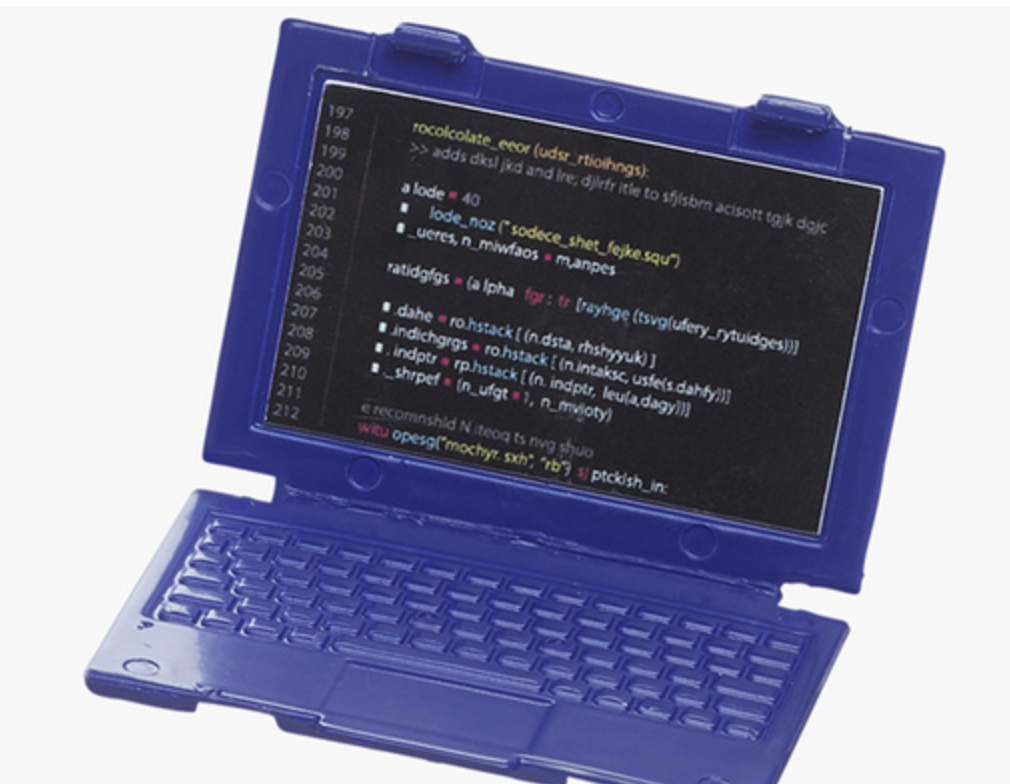
rocolcolate_eeor(udsr_rtioihngs):
>> adds dksl jkd and lfr, djlrfr itle to sfjlsbrn acisott tgjk dgjc
a lode [red square] 40
[white square]    lode_noz(“sodece_shet_fejke.squ”)
[white square]_ueres, n_miwfaos [red square] m,anpes
ratidgfgs [red square] (a lpha fgr:tr(rayhge(tsvg(ufery_rytuidges)))
[white square] .dahe [red square] ro.hstack[(n.dsta, rhshyyuk)]
[white square] .indichgrgs [red square] ro.hstack[(n.intaksc, usfe(s.dahfy))]
[white square] .indptr [red square] rp.hstack[(.n.indptr, leu(a.dagy))]
[white square] ._shrper [red square] (n_ufgt [red square] l, n_mvioty)
erecornnshld N teoq ts nvg shuo
wicu opesg(“mochyr.sxh”, “rb”) sj ptckish_in:
SPOILERS AHEAD! Stop reading if you want to work on this puzzle without spoilers.
Where is this code from? The pink script from the March 2026 Inner Circle PDF newsletter is clue. The color and font were related to the Barbie ecosystem
One of the recent Barbie bundles is Astronaut, with a laptop. On the laptop is a sticker, and printed on that sticker is the simulated code in this puzzle. The structure is very much Python with numpy and scipy sparse matrices. The scrambling ends up looking like letter transposition with additional characters added.
So, what does this code do? Here’s two takes.
Take Onerocolcolate_eeor(udsr_rtioihngs)
def concatenate_user(user_ratings):
# adds row and col, adjusts shape to existing sparse matrix
n_items = 40
# a lode might be n_items, [red square] = assignment
m = load_npz(“source_data_file.npz”)
# lode_noz might be load_npz, .squ might be .npz
_users, n_samples = m.shape
# confident: _ueres might be _users, m,anpes might be m.shape
ratings = csr_matrix(
# ratidgfgs might be ratings, tsvg might be csr_matrix
[alpha * r for r in range(reshape(user_ratings))]
# inferred: list comp structure made visible
)
ratings.data = np.hstack([m.data, ratings_new.data])
# .dahe might be data, ro. might be np.
ratings.indices = np.hstack([m.indices, csr(s.indices)])
# .indichgrgs might be .indices
ratings.indptr = np.hstack([m.indptr, len(a.data)])
# leu might be len, a.dagy might be a.data
ratings._shape = (n_users + 1, n_items)
# ._shrpef might be ._shape, n_ufgt+
# e recomnshld N might be “if recommended N items not enough show”
# But confidence not that high about this particular line.
with open(“morph.pkl”, “rb”) as pickle_in:
# mochyr.sxh might be morph.pkl, ptckish_in might be pickle_in
model = pickle.load(pickle_in)
Take Two
def recalculate_error(user_ratings):
“adds dksl jkd and lfr, djlrfr itle to sfjlsbrn acisott tgjk dgjc” could be “adds data, indices and indptr, delivering it to sparse matrix object”.
It uses a compressed sparse matrix format. This might be scipy.sparse.csr_matrix or load_npz
# Load the base dataset and model configuration
loader = 40 # Sample parameter or matrix rank threshold
n = sp.load_npz(“sparse_sheet_fake.npz”)
# Extract structural dimensions
n_users, n_movies = n.shape
map_new_ratings = user_ratings
# Process the new incoming user ratings arrays
# (alpha format: targeting the ratings given by user)
new_data = np.array(list(user_ratings.values()))
new_indices = np.array(list(user_ratings.keys()))
# Append the new user’s interaction data to the sparse matrix
# components
n.data = np.hstack((n.data, new_data))
n.indices = np.hstack((n.indices, new_indices))
n.indptr = np.hstack((n.indptr, len(n.data)))
n._shape = (n_users + 1, n_movies)
# Load the trained model to perform recommendations/error check
with open(“model.pkl”, “rb”) as pickle_in:
model = pickle.load(pickle_in)
return model
Take Three?
What’s your take?
Did you enjoy the puzzle?
Do you have a puzzle to share?
Let us know!